

Costs and pricing
Property creators return on investment: a framework
Measure property creators return on investment by defining a counterfactual, tracking agent outcomes, calculating contribution and setting stopping rules.
Property creators return on investment is defensible only when the analysis estimates what changed because of a defined property-media intervention, then compares that incremental contribution with full economic cost. Views, enquiries, platform attribution and gross transaction value do not establish causality.
This method is for organisational decisions, not personal property or financial advice. It supplies no England benchmark, expected return or success probability.
What to take away
- Property-media return on investment needs a counterfactual, not views or platform attribution.
- Define the decision, outcome and exclusions before you look at any results.
- Use contribution after variable costs, never gross turnover or property value.
- Keep formulas blank until valid evidence exists and report uncertainty beside results.
- Stop measurement when the design is underpowered or the confidence range crosses the threshold.
Specify the decision
Name the commissioning organisation, eligible English population, property and media scope, channels, intervention dates, comparison period and outcome. For estate-agent marketing, specify whether creator content ran on Instagram, TikTok or YouTube, or whether the intervention is a listing placement on Rightmove, Zoopla or OnTheMarket; keep distinct interventions separate. Outcomes might be qualified valuation enquiries, instructions won, viewings, offers, completed sales or lets, or fall-throughs, with a documented contribution basis; engagement alone is not a commercial outcome.
Where available, use UTM campaign parameters in Google Analytics 4 and agency CRM records alongside platform or portal reports. These can record reported journeys and lead sources, but do not show what would have happened without the content.
Pre-Specify Decision Elements
- Name commissioning organisation
- Define eligible English population
- Set property and media scope
- List channels and intervention dates
- Set comparison period and outcome
- Define exclusions before results
Write the causal question: what would probably have happened to the same outcome, in the same period, without this content? The answer is the counterfactual. A previous month is not automatically suitable because season, property supply, prices, other advertising and operational changes can differ. Use HM Land Registry Price Paid Data and the ONS UK House Price Index to describe market context, not as substitutes for outcome records from a contemporaneous comparison group. Where feasible, compare comparable branches or postcode areas in the same period using the agent's own CRM outcomes.
Choose a proportionate design
HM Treasury's The Magenta Book: Central Government guidance on evaluation says impact evaluation examines causal effects and alternative explanations. Where feasible, pre-specify a randomised or credible quasi-experimental comparison. Record allocation, eligibility, sample size, missing data, spillovers and deviations.
Choose Proportionate Design
Is a randomised or credible quasi-experimental comparison feasible?
Pre-specify allocation, sample size, spillovers
Use theory-based contribution analysis
If that design is not feasible, a theory-based assessment can examine contribution using several evidence sources. The Magenta Book analytical annex warns that contribution analysis offers an evidenced line of reasoning rather than definitive proof. Do not turn it into a precise causal percentage.
Define the money measure
Use contribution, not gross turnover or property value. Record the GBP amount retained after directly related variable costs for one eligible incremental outcome, with its accounting source, period, VAT and tax treatment. Exclude pass-through sums and money that belongs to another party.
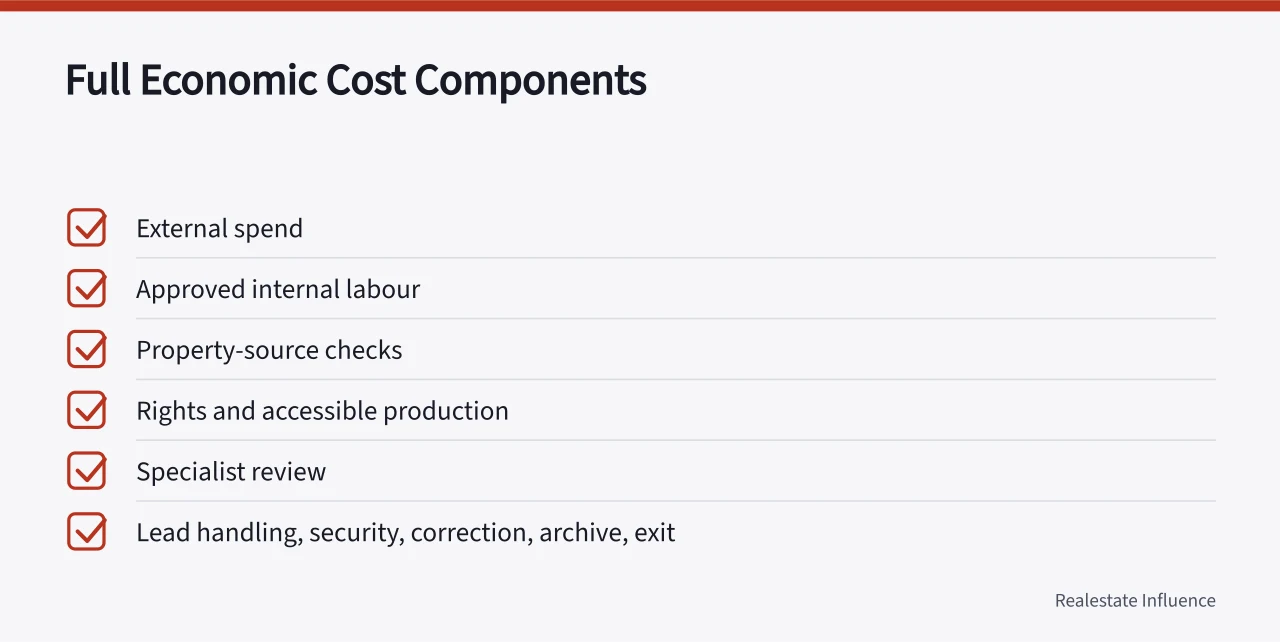
Build full economic cost from external spend, approved internal labour, property-source checks, rights, accessible production, specialist review, lead handling, security, correction, archive and exit. A pre-owned camera may have no new cash payment but still has an opportunity or usage cost if the organisation has an approved method for it.
Calculate without hiding assumptions
Keep formulas blank until valid evidence exists:
incremental eligible outcomes = observed eligible outcomes minus counterfactual estimate;incremental contribution in GBP = incremental eligible outcomes x GBP contribution per outcome;net incremental return in GBP = incremental contribution minus full economic cost in GBP;ROI percentage = net incremental return divided by full economic cost x 100.
State denominator, currency, period, VAT basis, inclusions, exclusions and uncertainty interval beside the result. Report sample attrition and data-quality failures. Never replace missing contribution with average property price, mortgage balance or an invented lead value.
Test sensitivity and stopping rules
Vary the counterfactual, contribution per outcome, missing-data treatment, attribution window and whole-life cost using sourced bounds. Label downside, central and upside cases as scenarios; do not assign probabilities without evidence.
Set the organisation's decision threshold before launch; do not substitute an unsupported generic property-sector benchmark. Stop or extend measurement when the design is underpowered, groups are not comparable, tracking changes, substantial activity occurs outside the intervention, rights or privacy conditions fail, or the confidence range crosses the organisation's decision threshold. A negative or uncertain result should not be recast as brand value without a separately specified measure.
Advertising and regulatory compliance remain outside ROI. If content is a financial promotion, check section 21 of the Financial Services and Markets Act 2000 and the FCA's Finalised Guidance FG24/1 on financial promotions on social media; a qualified reviewer should determine whether they apply. Neither compliance nor a profitable campaign establishes causal impact. A named evaluation reviewer signs the causal method, while qualified property, advertising, FCA, privacy, tax and commercial reviewers retain authority over their subjects.
Before you act
- Name the commissioning organisation, population, scope, channels and dates.
- Write the causal question and define the counterfactual before analysis.
- Pre-specify a randomised or credible quasi-experimental comparison where feasible.
- Record contribution per outcome with its accounting source and tax treatment.
- Build full economic cost including rights, review, security and archive.
- Set stopping rules and label downside, central and upside scenarios.
Common questions
Why is a previous month not automatically a suitable counterfactual?
The text says season, property supply, prices, other advertising and operational changes can differ, so a previous month is not automatically suitable. The counterfactual should estimate what would probably have happened to the same outcome in the same period without the content.
What does contribution analysis prove according to the Magenta Book annex?
The Magenta Book analytical annex warns that contribution analysis offers an evidenced line of reasoning rather than definitive proof. The article says you should not turn it into a precise causal percentage, and a theory-based assessment can examine contribution using several evidence sources when a stronger design is not feasible.
When should measurement stop or be extended?
Stop or extend measurement when the design is underpowered, groups are not comparable, tracking changes, substantial activity occurs outside the intervention, rights or privacy conditions fail, or the confidence range crosses the organisation's decision threshold. A negative or uncertain result should not be recast as brand value without a separately specified measure.